
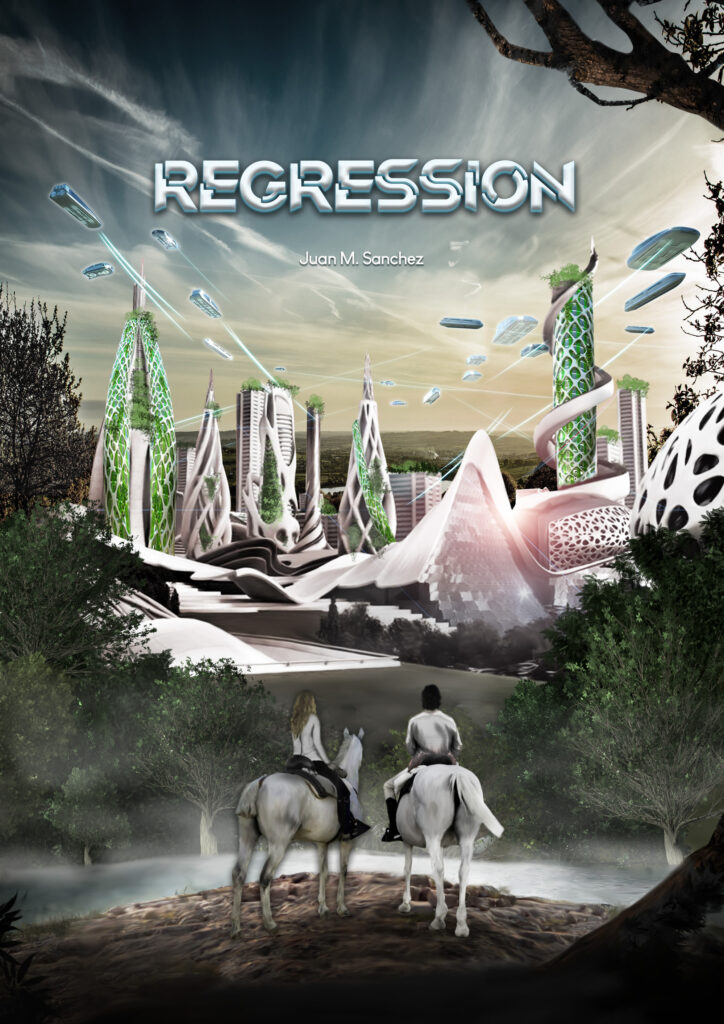
Synopsis:
In two thousand years, people have achieved harmony with each other, with technology and nature. They live long and happy lives, based on two main principles: freedom and progress.
There has been a leap in intelligence, so brains are wired differently, in such a way that people control their instincts and are more observant. However, some are born with a condition called regression, meaning their brains are wired the same way ours are wired today.
Such people are more romantic, chaotic and less self-aware. To help us understand our role in nature and life, the narrator tells about life in the future and the story of a relationship between a regressive man and an ordinary woman .
…
…
Part Two:
to be continued soon…
Watch the audio-book with video images: https://www.youtube.com/watch?v=B59EiMSEwQE&t=1s
Plot, themes, and motifs:
Regression — Summary
Regression is a philosophical science-fiction novel framed as a message sent backward through time from the year 4351 (and later 4422) to readers in the present day. A future narrator explains that the book isn’t fiction but “retroinstruction” — an attempt to subtly influence the past by overwriting an existing novel’s content, since direct time travel is impossible but information can be transmitted through a kind of temporal entanglement.
Structure & Narrators
The novel shifts between several narrators:
- Efrain Zielinski, a veterinarian in a future utopian Poznań, who begins writing this account as a personal diary/novel
- Conrad, a philosopher from a still-further future (4422) who “entangles” with Efrain’s narrative partway through
- Valentin himself, who gets a chapter in his own voice
Plot
Efrain lives in a post-scarcity, hyper-rational utopia: work is minimal, relationships are algorithmically matched, emotions are managed, meat-eating and religion are extinct, and society runs on a “pragmatic ethics” system called positive discrimination. Into this world comes Valentin, a man born with “regression” — an atavistic condition that makes him think and feel like a person from the deep past: romantic, self-destructive, poetic, irrational.
Valentin falls obsessively in love with Milena, a psychologically “normal” young woman, in defiance of social convention (regressed people are meant to stay isolated). Their relationship becomes a scandal and a case study. Efrain, drawn into friendship with Valentin, eventually commits a “crime” by illegally revealing information about Milena’s future to him — an act that appears to alter the course of events. Milena breaks up with Valentin, undergoes therapy, but ultimately returns to him, defying the rational, algorithm-driven norms of their society. The novel closes with the couple living in exile together, and with philosophical meditations (via Conrad) on whether their “irrational” love represents evolutionary regression or a necessary rebellion that reintroduces chaos and freedom into an overly harmonious civilization.
Themes
- Reason vs. passion / order vs. chaos: The utopia has optimized away suffering, spontaneity, and risk — but also freedom and creativity. Valentin embodies a return of the irrational as a corrective, even a necessary “evolutionary” force.
- Determinism and free will: Extended dialogues (especially Valentin’s “gunpoint” argument) probe whether choice under constraint is truly freedom.
- The malleability of memory and time: The novel’s central conceit — that the past and future can be altered but the present cannot — is used to explore identity, consciousness, and the nature of storytelling itself.
- Utopia’s hidden costs: Efficiency, positive discrimination, algorithmic matchmaking, and universal “pragmatic ethics” produce comfort at the cost of individuality, risk, and authentic desire.
- Nature vs. artifice: Recurring distrust of cyborgization, virtual reality, and AI in favor of “natural” evolution, alongside heavy genetic engineering — an unresolved tension the book doesn’t fully reconcile.
- Truth and paradise as a paradox: Later chapters argue that a static, suffering-free “paradise” is indistinguishable from hell, and that meaningful existence requires disruption and even unhappiness.
Motifs
- The Cosmic Microwave Background sound marking narrator/chapter transitions, tying the story to cosmic/temporal scale
- Horses (tame vs. wild) as a recurring symbol of domestication vs. primal nature
- Flowers (the “dead flower tax,” the transparent peonies) symbolizing regulated vs. authentic sentiment
- Mars colonization as a parallel narrative of humanity extending itself outward, mirrored against Valentin’s inward “regression”
- Multiverse/parallel-universe theory, repeatedly raised and refuted, reinforcing the book’s single-timeline, “existence prevails over time” cosmology
The novel is essentially a philosophical dialogue in narrative form — using a Romeo-and-Juliet-style romance to stage a debate between rationalist utopianism and romantic irrationalism, wrapped in an elaborate science-fiction frame about time, memory, and communication across millennia.
If you enjoyed the book, as a token of admiration, you can leave me a comment or send a symbolic payment to my PayPal account: soy_juanma86@yahoo.com
***
