
The ink has barely dried before the first whispers reach your ears. Couriers, trembling under the weight of their own fear, deliver missives from Zalenice: Claudius has read your letter. His wrath burns hotter than the midday sun on the plains. You feel it before it is spoken — a storm gathering beyond the horizon.
Within days, banners rise along the northern hills, black and gold against the pale winter sky. The drums of war echo across the valleys, a relentless heartbeat of iron and intent. Claudius has declared you a rebel, an outlaw, a traitor to the Empire he forged. The open letter was a challenge, and the response is fire.
You ride through Moravice’s streets, your cloak tugging against the wind, and see fear mirrored in the eyes of the people. Traders shutter their windows; mothers clutch children to their breasts. Even the stones of the city seem to hold their breath, waiting for the approaching storm.
The first siege begins as the Emperor’s banners loom over the riverbanks. His forces are numerous, disciplined, and well-fed, their engines of war sending stone and flame over the outer walls. Your soldiers fight with the courage of desperation, steel singing and shields shivering under the hail of arrows. You ride among them, your blade a spark of defiance, but each heartbeat carries the reminder: the Emperor’s wrath is relentless.
Night falls, and still the assault does not abate. Fires smoke the sky, illuminating your city in an infernal glow. For hours you think of retreat, of flight, of surrender. But Moravice is more than stone and banner — it is memory, blood, the legacy of your forefathers. And so you hold.
In the darkness, you meet your council beneath the citadel. The lords gather, cloaks heavy with cold, their eyes wary. “We have held them off,” you say, “but it will not last. Claudius will return with more men. We need allies. We need resources. We need every coin, every blade, every measure of grain to prepare for war.”
A murmur runs through the hall. The city’s treasury is nearly emptied. Supplies are stretched thin. “If we continue,” one elder says quietly, “Moravice may survive the siege, but the people will starve before the next moon.”
Another lord leans forward, hands folded. “Perhaps we can appeal to the neighboring duchies. They fear Claudius’s expansion as we do. They might offer trade, mercenaries, anything to keep his army from reaching their borders.”
You nod. Diplomacy becomes a blade in itself, sharper than steel. For the next year, your days are spent negotiating, your nights preparing defenses, your every thought consumed with strategy. You ride to distant allies, beg for support, barter with the stubborn, persuade the wary. Every silver coin, every wagon of grain, every soldier raised is devoted to one purpose: the survival of Moravice.
You hold. Time stretches like a taut rope. Claudius tests you again and again, sending detachments, threatening more devastating assaults, but each attack falters against walls reinforced, provisions stockpiled, and the unbroken spirit of those who fight beside you.
Yet in moments alone, you feel the weight of what you have done. Every decision you make — every sword sharpened, every fire stoked — is a choice that shapes life and death, and the burden presses your chest until you remember the desert and its mantra, the fragments of reflection that first taught you to see clearly. The empire may be vast, the Emperor absolute, but the future is neither his nor yours alone. It is still, somehow, a river that flows through Moravice.
Then, one day, the messengers come again. Their words chill your blood: Claudius offers peace. Not honor. Not equality. Not recognition of your freedom. Only vassalage — a formal subjugation, thinly gilded with courtesy. The city would survive, yes, but at the cost of its autonomy, its independence, its soul.
You call your council once more, the lords gathering around the polished oak of the hall. Their faces are weary, lined with both sweat and calculation. The room is thick with tension, as though the very air knows the weight of the decision.
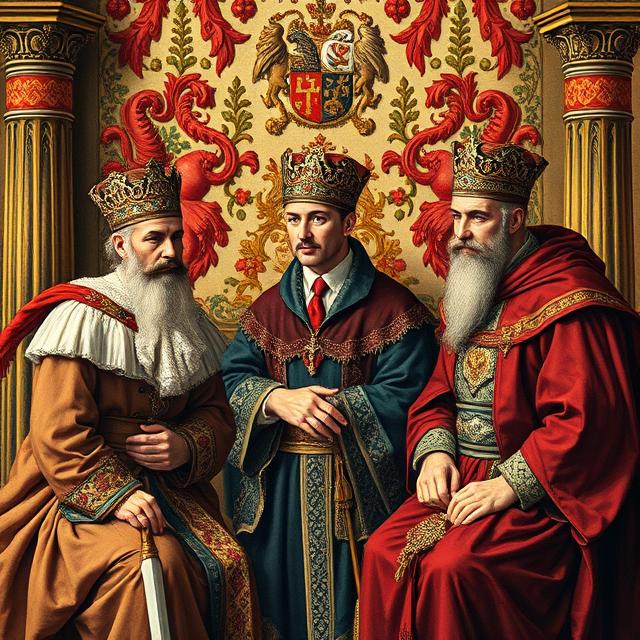
“The Emperor offers peace,” you begin, your voice low, measured, yet carrying the urgency of truth. “It is not flattering. It is not equal. It is vassalage disguised as courtesy. Accept it, and Moravice survives, but it is no longer ours. Decline, and we risk all we have built — our lives, our people, our lands — in a war we cannot be certain to win.”
A murmur runs through the assembly. One lord shifts uneasily, his hand brushing the hilt of his dagger. “You know what he commands,” he says. “We cannot match his armies again. Our men are weary, our coffers nearly bare. The city will survive this year, perhaps another, but for how long?”
Another voice rises, quieter but sharper: “And what of honor, my lord? If we bend now, what signal do we send? To our neighbors, to our children? To the people who have bled for this land?”
Half the council leans toward caution, toward survival; the other half remain neutral, weighing the risk, uncertain of their loyalty when the moment of truth arrives. Only one stands firm — a young lord whose eyes still carry fire. “Freedom is the soul of Moravice,” he declares, voice unwavering. “We swore allegiance to you as our protector, not to the Emperor as our master. If war comes, I will ride at your side, and I will fight.”
You study the council, each face reflecting fragments of fear, ambition, and pragmatism. You hear again the echoes of your desert mantra — the lesson that truth is never singular, that mirrors are always broken. Each lord’s loyalty, each soldier’s courage, each citizen’s trust is a reflection of your choices. You are the center, but not the whole.
The question is laid bare before you: survive and compromise, or risk all for freedom. Accept the vassalage, and Moravice endures, but its spirit bends. Refuse, and the Emperor’s wrath will descend with certainty, and you cannot be sure even those who now sit with you will not falter.
You pace the hall, hands brushing against the stone walls, cold as the weight of your decision. Your mind flickers to the shard of black glass, to the signet, to every choice you have made since the dunes of your desert ride. All mirrors are broken, you recall, but now you understand: brokenness does not diminish truth. It reveals it in shards.
The room is silent. Even the wind outside the battlements seems to wait. You sense that whatever you choose, it will define not only the fate of Moravice, but your own understanding of courage, loyalty, and destiny.
You consider the path of compromise — vassalage, peace, security. It is safe. It preserves life. But your heart trembles at its cost: a city ruled, but not free; a people protected, but not sovereign.
You consider the path of defiance — open war, uncertainty, potential ruin. It is dangerous, perhaps fatal. But it carries the possibility of freedom, of truth unbound, of a legacy forged without chains.
The young lord watches you, unwavering. You see his reflection, a shard of clarity in a hall of fractured mirrors. One life, one choice, one spark.
And then you speak, not to the council, but to yourself: “To live fully is to embrace the shards of reality, to see the reflections of all who trust us, and to act in accordance with what our heart recognizes as truth.”
The lords lean forward. Some nod, some frown, some shift in the weight of their hesitance. The answer lies not in them alone, nor in the risk of battle, nor in the Emperor’s gaze. The answer lies in you — the keeper of Moravice, the heir of forefathers, the bearer of choice.
You feel the desert’s mantra echo, not as words, but as understanding: that destiny is not given, it is forged. That truth is not found, it is chosen. That even in the face of overwhelming power, one’s own path remains the only ground where courage can take root.
The council waits. The candles flicker, shadows leaping across maps of rivers and walls and faraway plains.
And you know: you must choose.
….
…..

One Comment