
The Emperor’s advisors arrive at dawn. They come not with the pomp of conquerors, but with quiet authority, as if the stones themselves pause when they enter the hall. Three of them: Chancellor Ardan, precise and calculating, with a mind that moves like a clockwork gear; Livia, scholar of trade and irrigation, whose gaze misses nothing; and Father Emeric, a cleric whose voice is low, calm, and carrying a weight you feel in your chest.
They bow to you. “By the grace of Claudius,” Ardan says, “we serve Moravice—and you, my lord.”
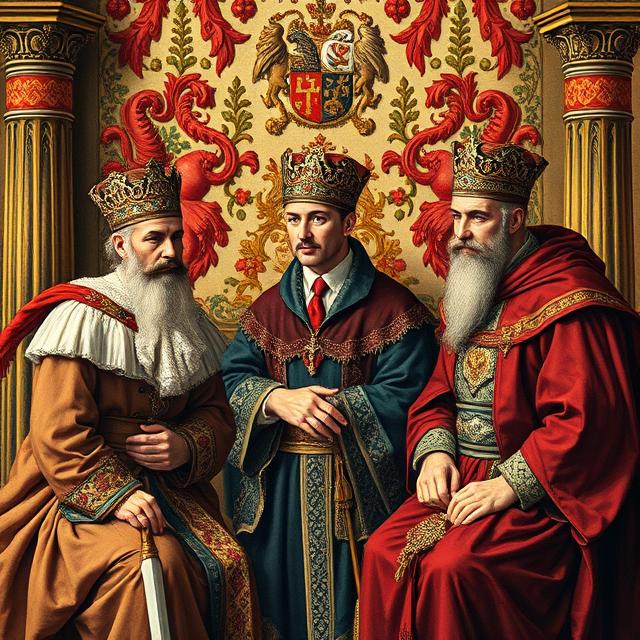
You nod, still wary. You have feared spies and wardens, betrayal under silk robes and courteous smiles. Yet the air changes subtly around them, as if the hall itself leans closer to listen.
Weeks pass. They speak of new methods of governance, of reforms, of irrigation, of roads and schools. Words that should feel hollow begin to take root in your mind, solid as stone. The city responds: smoke clears from towers; wells run deep and clean; canals bring life to parched fields; devices Livia brings from Zalenice shift water like tamed serpents; Father Emeric fills empty halls with children’s voices learning letters and history; Ardan reforms taxes so no man goes hungry while others grow fat.
You watch Moravice prosper.
And slowly, your doubts begin to dissipate. Perhaps Claudius is not the tyrant you imagined. Perhaps his dream of unity is not built on deceit, but on the careful shaping of fragile things.
At night, you stand on the citadel balcony and look down at the lit streets below. Children play. Merchants barter, laughing, without fear. The banners of Moravice flutter beside those of Zalenice without hostility. The people no longer whisper of rebellion or empire—they speak of life.
Yet your heart is not light.
You write letters to Aldebryn, to Margaret. You do not ask forgiveness; you only wish to know that she lives, that she remembers the river, the olive trees, the promise between you.
No answer comes.
Then, one day, a messenger arrives. He bows before you and hands over a sealed letter. It is not her hand, but her brother’s.
“Lady Margaret is to be wed this spring to Lord Soren of Värmdö, a Swedish nobleman. She is well, her spirit content. She bids no message, but wishes peace upon all lands.”
The words strike you like a whip.
Days pass. You attend council as usual. Livia presents plans for a bridge across the eastern riverbank; Ardan outlines new tariffs and trade routes; Emeric speaks of literacy among the peasantry. You nod, speak words of praise, applaud their work. Yet your soul feels hollow, a desert where laughter and banners cannot reach.
You wander the streets at dusk, unseen beneath your cloak. Children run past. Merchants argue. Soldiers boast. All this is yours, yet it is not. These people, these streets, this city—are they yours? Or Claudius’s, shaped by his law, molded by his vision?
You feel trapped in the clogs of power, bound by invisible chains. You think of the mantra from the desert:
—All mirrors are broken.
—I’m looking at myself,
—Reflected on the sand.
—On every grain of sand.
—Reflected on people.
—On every pair of eyes looking at me.
—I am with others and in others.
—And there I remain eternal.
—Alone I’m not, and I never was.
You cry. You do not understand. You cannot see how it fits into this world of coins, banners, and endless loyalty.
Then a magus appears. Or a witch or just an old wench whose face carries too many stories.
A bent figure in a ragged cloak stands at the edge of the marketplace. Her hair is gray, her back stooped, her steps slow. Yet something in her presence makes your pulse catch—a memory, a certainty in the pit of your stomach.
She moves toward the road northward out of the city. Something inside you insists that you follow. You leave the guards behind. The streets are silent, and even the wind seems to wait.
She walks beyond the vineyards, where the stream threads through the hills like silver silk. At last, she stops.
“You’ve been following something you cannot reach,” she says.
“What is it I follow?” you ask.
“The truth,” she says simply.
“Truth?” you laugh, bitterly. “Is there any in this world? I am surrounded by Claudius’s empire, by advisors, by vassals, by coins and banners. What does truth even mean here?”
Her head tilts, faintly amused. “There is truth. But it is not given—it is chosen…. by you.”
“How can truth depend on me?”
“You either forge your destiny or are melted by life and cast in its shape. That is the truth that matters.”
You slump onto a stone by the stream. “Then I am melted,” you whisper. “I am untrue to myself. I do not know who I am anymore.”
“Be brave,” she says, stepping closer. “Choose truth over fear.”
From her pouch she produces a mushroom, small and pale, faintly luminescent. She places it in your palm.
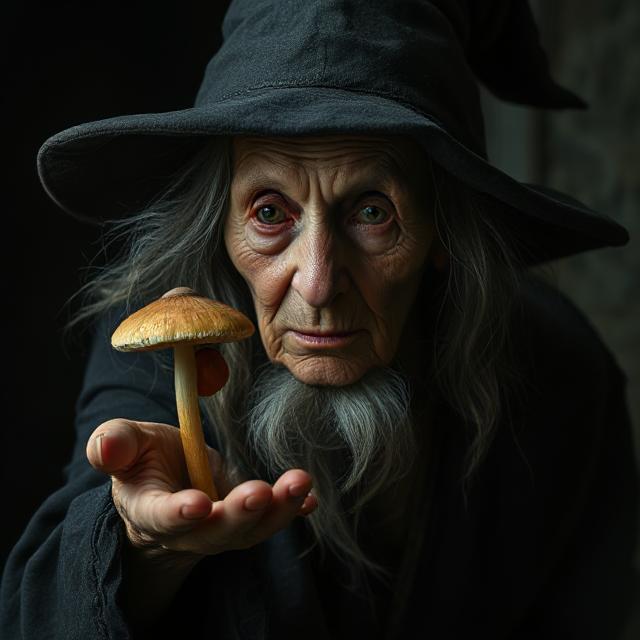
“You can sometimes hold truth in your hand,” she says. “And waste it. Toss it away. But truth always comes down to bravery.”
Before you can ask more, she disappears into the mist rising from the stream, leaving only the sound of the water and the wind through the reeds.
You stare at the mushroom. Its glow is faint but steady.
The stream reflects your hand. Your reflection trembles. The world seems to hold its breath.
Truth or fear.
You think of Margaret, walking into another life without you. Of Claudius, with his careful, golden hand shaping empires. Of Ignacjusz dying, whispering of old blood and destiny.
You think of yourself—the man who has rebuilt a city, commanded an army, won a kingdom, yet cannot name his own desire.
You close your fingers around the mushroom.
The wind rises suddenly, scattering frost along the hills. Leaves brush against your face like unseen hands.
“All mirrors are broken,” you whisper.
The mushroom’s glow deepens in your hand. You lift it to your lips. Your heart beats fast. The stream ripples, and the reflection shimmers—one real, one inverted, both trembling.
And then you take a bite.
The world dissolves.
The stream, the hills, the frost, the Magus—they blur. Mirrors shatter. Sand, sky, water, and memory fold into each other. You feel yourself unmade and remade in the same instant, as though the mantra from the desert is alive inside you:
—All mirrors are broken.
—I’m looking at myself,
—Reflected on the sand.
—On every grain of sand.
—Reflected on people.
—On every pair of eyes looking at me.
—I am with others and in others.
—And there I remain eternal.
—Alone I’m not, and I never was.
It pierces your mind. You do not cry. You do not scream. You see. Not the city, not Claudius, not Margaret. Only the infinite threads that connect you to the world, the endless reflection of yourself in every action, every choice, every life touched by yours.
The mushroom tastes faintly bitter, earthy, metallic—and somehow sweet, like sunlight on wet sand.
You rise, unsteady but certain. The stream sparkles. The wind feels alive. And for the first time since the desert, since the gates of Moravice, since the first taste of power, you feel like the master of your own destiny.
Not because the city is yours, not because the advisors serve you, not because Claudius smiles from afar. But because you know—as the mantra whispers and the mushroom hums in your blood—that you are with others, and in others, and therefore eternal.
The Magus watches from the shadows, and her eyes gleam with understanding—or perhaps amusement. She does not speak. She only nods.
You take a deep breath. The frost bites at your cheeks. The wind carries the scent of pine, of wet earth, of life itself.
And you step forward, leaving the stream, leaving the hill, leaving the doubt behind.
The world is vast. Your choices are yours. And at last, you feel the weight of destiny balanced in your own hands.
….
You eat the rest of the mushroom
…..

One Comment